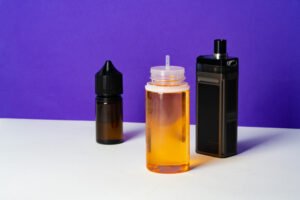
Vegetable glycerin (VG) and propylene glycol (PG) are two of the most common base liquids used in e-liquid formulations. They have different physical properties, and those differences influence how an e-liquid behaves when it reaches a heated vape coil. Understanding these characteristics is useful for anyone researching the VG PG ratio and how it affects e-liquid performance.
When an e-liquid is heated, the coil transfers thermal energy to the liquid surrounding the wick. VG and PG respond to that heat according to their individual properties, while the exact behaviour also depends on coil temperature, power, airflow, wicking and the overall formulation.
What Are VG and PG?
Vegetable glycerin, commonly called VG, is a clear, colourless and relatively thick liquid. It is widely used as a base ingredient in e-liquids and is known for its viscosity and ability to contribute to aerosol production.
Propylene glycol, or PG, is a thinner liquid with a lower viscosity than VG. It is commonly used as a carrier for flavour compounds and contributes characteristics such as flavour delivery and throat sensation.
Manufacturers combine these ingredients in different proportions. This proportion is known as the VG PG ratio.
A 50/50 ratio, for example, represents an approximately equal balance of VG and PG. Other formulations can contain a higher proportion of either ingredient depending on the intended characteristics and hardware.
What Happens When VG Reaches the Coil?
When VG is heated by a vape coil, thermal energy causes the liquid to transition into an aerosol-forming state. VG’s relatively high viscosity influences how it moves through the wick before reaching the heating surface.
Because VG is thicker, its movement through a wicking material depends significantly on the design and structure of the wick. Temperature, coil construction and e-liquid formulation also affect how efficiently VG reaches the heating area.
VG is widely associated with dense aerosol production. Its physical properties contribute to the characteristic vapour output often associated with higher-VG formulations.
How Does PG Behave During Heating?
PG has a thinner consistency, allowing it to move through wicking materials more readily under suitable conditions. When heated by the coil, PG contributes to aerosol formation and carries flavour compounds into the resulting vapour.
Its lower viscosity makes PG behave differently within the wicking system compared with VG. This is one reason the VG PG ratio can influence how an e-liquid performs in different types of vape hardware.
PG is also associated with a more noticeable throat sensation. The perceived effect can vary according to PG concentration, nicotine content, flavour ingredients, device power and individual sensitivity.
Why Does Viscosity Matter?
Viscosity describes a liquid’s resistance to flow. VG has a higher viscosity than PG, meaning it is thicker and flows more slowly under comparable conditions.
This difference becomes particularly relevant when e-liquid moves from the reservoir through the wick toward the coil.
A higher-VG formulation generally has a thicker consistency, while a higher-PG formulation is generally thinner. The VG PG ratio therefore influences how easily an e-liquid moves through the device’s wicking system.
Coil and wick designs are often developed with particular liquid characteristics in mind.
How Does Heating Affect Flavour?
Heating converts the liquid into an aerosol that carries flavour compounds toward the mouthpiece. PG’s ability to act as a flavour carrier makes its proportion relevant to flavour delivery.
VG also participates in the aerosol-generation process, contributing body and density to the vapour.
The overall flavour perception depends on the complete formulation. Flavour concentrates, nicotine, coil temperature, airflow and the VG PG ratio can all contribute to the final result.
This means that the behaviour of VG and PG during heating should be viewed as part of a larger system rather than as isolated properties.
Does the VG PG Ratio Affect Vapour Production?
Yes, the VG PG ratio can influence aerosol production. VG is commonly associated with greater vapour density, while PG produces a lighter aerosol and is widely valued for flavour carrying.
Increasing the VG proportion generally increases the amount of VG available to the heating system. Increasing PG changes the formulation toward a thinner liquid with stronger emphasis on PG’s flavour-carrying characteristics.
The resulting aerosol also depends on power output, coil surface area, airflow and puff duration.
How Does Coil Temperature Influence VG and PG?
Coil temperature is one of the most important variables in the heating process. The temperature reached by the coil depends on factors such as electrical power, coil resistance, airflow and the characteristics of the device.
When the coil reaches its operating temperature, the e-liquid near the heating surface receives thermal energy and forms an aerosol.
The exact behaviour of VG and PG depends on the temperature and conditions at the coil. Consistent e-liquid supply is also important because the wick needs to deliver liquid to the heating surface during operation.
Why Does Wicking Matter?
Wicking is the process through which e-liquid moves from the reservoir toward the heating element. Because VG and PG have different viscosities, their movement through the wick differs.
A formulation with a high proportion of VG may require a wicking system capable of handling thicker liquid efficiently. A formulation containing more PG generally has a thinner consistency.
The VG PG ratio therefore provides useful information about an e-liquid’s physical properties and potential interaction with different coil systems.
How Does Airflow Interact With Heating?
Airflow influences the environment around the heating coil. Air entering through the device passes across the heating area and mixes with the generated aerosol.
Greater airflow changes the amount of air moving through the coil area, while more restricted airflow changes the balance between incoming air and aerosol.
Because airflow interacts with coil temperature, vapour production and puff characteristics, it is another factor to consider when evaluating how VG and PG behave during heating.
What Does the VG PG Ratio Tell You?
The VG PG ratio provides a simple way of describing the composition of the e-liquid base.
Common formulations include:
- 50/50 VG PG for a balanced formulation
- Higher-VG blends for thicker liquid and greater aerosol production
- Higher-PG blends for thinner consistency and stronger emphasis on flavour carrying
The ratio does not describe every characteristic of an e-liquid. Flavour concentrates, nicotine strength, coil specifications and device settings also influence the final experience.
Why Is Understanding Heating Behaviour Useful?
Understanding how VG and PG respond to heating helps explain why different e-liquids are formulated for different types of hardware.
A device’s coil, wick, airflow and power system interact with the e-liquid throughout every activation. The VG PG ratio provides useful information about the liquid’s viscosity and the balance of characteristics associated with VG and PG.
This information can help consumers interpret product specifications and understand why e-liquids may behave differently across different devices.
About ABC Vape
ABC Vape is a Canadian online vape shop offering disposable vapes, vape pods, e-liquids, e-juices and vaping accessories. Its product selection includes brands such as Allo, STLTH, Elfbar, Flavor Beast, Insta Bar, Linvo, Orbito, Oxbar and Vice. ABC Vape serves Canadian customers through its online store and offers free delivery on orders above $100.
Conclusion
VG and PG have distinct physical properties that influence their behaviour when an e-liquid reaches a heated vape coil. VG is thicker and commonly associated with aerosol density, while PG has a thinner consistency and plays an important role in flavour carrying.
The VG PG ratio determines how these characteristics are balanced within an e-liquid. Coil temperature, wicking, airflow, power output and formulation also affect the heating process. Understanding these relationships provides a clearer technical picture of how e-liquid interacts with vape hardware and why different VG PG ratios are used across modern formulations.