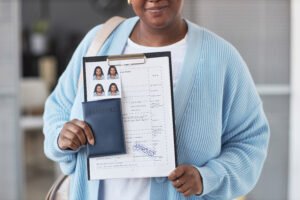
A photograph submitted with a Canadian permanent residence application must meet specific requirements so immigration officials can identify the applicant accurately. Details such as glasses, religious head coverings, facial expressions, lighting, and head positioning can influence whether a photograph meets the required standards.
Understanding permanent resident photo specifications before taking or submitting a photograph helps applicants avoid preventable delays and the inconvenience of providing a replacement image. Although certain personal or religious accommodations are permitted, the photograph must still satisfy the applicable identity and image-quality requirements established by Immigration, Refugees and Citizenship Canada (IRCC).
1. Why Canadian PR Photo Specifications Matter
A permanent resident photograph serves as an official identification image. It helps immigration authorities verify an applicant’s identity and supports the production of permanent resident documents.
IRCC provides specific instructions covering photograph dimensions, head size, background, lighting, facial visibility, and image quality. Applicants should follow the instructions associated with their particular application because photo requirements may differ depending on the document or submission method.
The permanent resident photo specifications generally require a clear, recent photograph showing the applicant facing the camera with a neutral expression. The face must be visible, evenly illuminated, and positioned appropriately within the image.
Following the current official instructions from the beginning helps applicants prepare photographs that are suitable for immigration processing.
2. Can Glasses Affect PR Photo Compliance?
Glasses can affect the quality and suitability of an identification photograph, particularly when lenses create reflections or frames obscure facial features.
For Canadian permanent residence photographs, applicants should follow the current IRCC instructions regarding eyewear. Prescription glasses may be acceptable when the eyes remain clearly visible, the lenses are free from distracting glare, and the frames do not cover the eyes.
Sunglasses and tinted lenses generally present identification difficulties because they obscure the eyes. Ordinary clear prescription lenses are more suitable when eyewear is permitted under the applicable instructions.
Before taking the photograph, check the following:
- Both eyes are clearly visible.
- Lens reflections do not cover the pupils.
- Frames do not obstruct the eyes.
- The lighting does not create distracting glare.
- The glasses sit naturally on the face.
If reflections appear during the photograph session, adjusting the light source or camera angle may improve the image. Applicants should consult the current IRCC photo guide for the precise eyewear requirements applicable to their application.
3. Are Religious or Cultural Head Coverings Permitted?
Head coverings may be permitted in Canadian permanent residence photographs when worn for religious or cultural reasons. The important consideration is whether the covering follows IRCC’s requirements and allows the applicant’s identity to be established.
Religious head coverings are generally acceptable when worn regularly for religious reasons, provided the face remains visible from the bottom of the chin to the top of the forehead and both sides of the face are visible. The covering should not cast shadows across the face or obscure essential facial features.
Applicants should consider these practical points:
- Position the covering so that the full face remains visible.
- Keep the forehead and chin unobstructed.
- Ensure both sides of the face are clearly distinguishable.
- Use even lighting to avoid shadows around the eyes and cheeks.
- Choose a plain, contrasting background that helps distinguish the head covering from the surroundings.
Medical or other circumstances may involve separate considerations. Applicants should review the relevant IRCC guidance for their situation and follow any specific instructions provided with their application.
4. What Facial Expression Is Required?
Facial expressions play an important role in identity photographs because they help officials assess facial features consistently.
The permanent resident photo specifications generally call for a neutral expression. Applicants should look directly at the camera, keep their mouths closed, and maintain a relaxed facial position. A natural expression with the eyes open and clearly visible is the most suitable approach.
Avoid exaggerated expressions, laughing, smiling broadly, raising the eyebrows significantly, or tilting the head. These movements can change the appearance of facial features and affect consistency with other identification documents.
A neutral expression does not require a tense or uncomfortable face. Relaxing the forehead, keeping the lips together naturally, and looking straight ahead usually produces an appropriate result.
For children and infants, the applicable instructions may account for practical challenges in obtaining a suitable photograph. Parents should consult the specific requirements for the applicant’s age group.
5. How Lighting and Shadows Affect Facial Visibility
Even when glasses and head coverings meet the relevant requirements, poor lighting can reduce photograph quality.
Strong light from one side may create shadows across the nose, cheeks, or eyes. Direct flash can produce glare on glasses, while insufficient light may cause facial details to appear unclear.
For a suitable photograph, use balanced lighting that illuminates the face evenly. Position the applicant facing the light source, and avoid strong backlighting from windows or bright backgrounds.
The background should be plain, light-coloured, and free from distracting objects. The applicant’s face and clothing should remain distinguishable from the background.
Check the finished image at full size before submission. Facial details should appear sharp, natural, and clearly visible without excessive editing or digital enhancement.
6. Check Photograph Dimensions and Head Position
Meeting the physical dimensions is just as important as having the correct facial expression.
Canadian permanent residence photographs have specific size and head-measurement requirements. The exact specifications depend on the applicable IRCC instructions, including whether the photograph is printed or submitted digitally.
Applicants should check:
- The required overall photograph dimensions.
- The specified measurement from chin to crown.
- The position of the head within the frame.
- The amount of space above the head.
- Whether the image meets the required resolution and quality standards.
The head should face forward and remain centred. Keep the shoulders level and the camera at approximately eye height to avoid distortion.
Do not rely solely on a general passport photo template. Permanent resident photographs may have requirements that differ from those used for other Canadian identification documents.
7. Review the Photograph Before Submitting It
A final review helps identify issues before the photograph accompanies an application.
Examine the photograph for reflections on glasses, shadows from head coverings, blurred facial details, uneven lighting, and incorrect positioning. Confirm that the expression is neutral and that the applicant’s face remains clearly visible.
Also check whether the photograph meets the applicable printing, digital file, and photographer information requirements. Some application processes require specific details on the back of a printed photograph, while digital submissions follow their own instructions.
Use the latest official IRCC photo specifications as the final reference. Requirements can change, so an older photograph or template may not match the instructions currently applicable to an application.
About Max Mobile and Gifts
Max Mobile and Gifts provides professional cell phone repair and iPhone repair services in Vancouver, Canada. The business also offers fob copying, key cutting, passport and PR photo services, mobile accessories, photocopying and printing, watch battery replacement, luggage, hip hop jewellery, perfume, and cologne. Its photo services support customers who need identification photographs prepared for official purposes.
Conclusion
Glasses, religious head coverings, and facial expressions can all affect whether a Canadian permanent residence photograph meets the applicable requirements. Clear eyes, visible facial features, a neutral expression, balanced lighting, and correct image dimensions help produce a suitable identification photograph. Applicants should always review the current permanent resident photo specifications published by IRCC before submitting their images, particularly when personal circumstances or eyewear require additional attention.