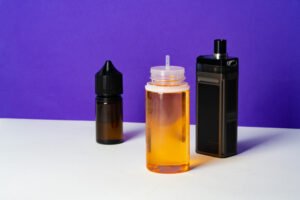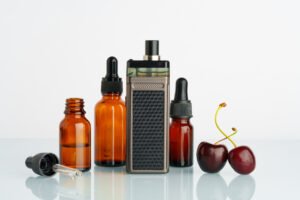
Seeing the same VG and PG ratio on two e-liquid bottles does not necessarily mean the liquids will feel or taste identical. VG, or vegetable glycerin, and PG, or propylene glycol, are important components of e-liquid, but they represent only part of the complete formulation.
Two e-liquids can have an identical VG and PG ratio while containing different flavour concentrates, nicotine types, flavouring concentrations, sweeteners, cooling ingredients, and other formulation components. The device and coil used with those liquids can also influence how their characteristics are experienced.
Understanding these factors helps explain why e-liquids with the same VG and PG ratio can still feel noticeably different.
What Does a VG and PG Ratio Actually Tell You?
The VG and PG ratio describes the proportion of these two base ingredients in an e-liquid. For example, two products may both use a 70:30 VG-to-PG formulation.
This information provides useful insight into the e-liquid’s viscosity and general vapour characteristics, but it does not describe the entire recipe.
The remaining part of the formulation can contain flavour concentrates, nicotine, and other permitted ingredients. These components can significantly influence the overall flavour, texture, and sensation.
Therefore, an identical VG and PG ratio does not mean that two e-liquids have identical characteristics.
Flavour Concentration Can Make a Major Difference
One of the biggest reasons two e-liquids can feel different is their flavour formulation.
An e-liquid may contain a simple single-note flavour, while another may combine multiple flavour concentrates to create a complex profile. Even if both use exactly the same VG and PG ratio, their flavour characteristics can be completely different.
For example, one fruit e-liquid may emphasize sweet notes, while another may combine several fruits with tart or aromatic elements. The VG and PG ratio remains the same, but the flavour formulation changes the overall experience.
The concentration of flavour ingredients can also influence how pronounced individual notes appear.
Different Flavour Ingredients Behave Differently
Not all flavour compounds interact with the VG and PG base in exactly the same way.
Fruit, dessert, beverage, tobacco-inspired, mint, and cooling profiles can contain different combinations of flavouring ingredients. Their individual characteristics influence the final formulation.
A creamy dessert profile may feel fuller and softer than a bright fruit profile, even when both use the same VG and PG ratio.
This demonstrates why VG and PG should not be considered the sole determinants of an e-liquid’s character.
How Does Nicotine Type Influence the Experience?
Nicotine formulation is another variable.
E-liquids can contain freebase nicotine or nicotine salts, and these forms have different chemical characteristics. Two e-liquids can therefore share the same VG and PG ratio while using different nicotine formulations.
The nicotine strength can also vary. A difference in nicotine concentration can influence the overall sensation of an e-liquid.
When comparing two products, looking only at VG and PG does not provide enough information to understand how the complete formulation may differ.
Sweeteners and Cooling Ingredients Can Change Perception
Some e-liquid formulations include ingredients designed to influence sweetness or cooling characteristics.
A sweeter formulation can emphasize certain flavour notes, while a cooling component can create a noticeably different sensation. These characteristics are independent of the VG and PG ratio.
For instance, two fruit-flavoured e-liquids with the same VG and PG ratio may have different levels of sweetness or cooling characteristics. The base ratio is identical, but the supporting formulation changes how the flavour is perceived.
Why Does Viscosity Still Matter?
Although the same VG and PG ratio can produce different experiences, the ratio still matters because it determines an important part of the e-liquid’s physical characteristics.
VG is naturally thicker than PG. Increasing the proportion of VG generally increases viscosity, while increasing PG generally produces a thinner formulation.
Viscosity affects how the e-liquid moves through the wicking system and reaches the coil. However, two e-liquids with the same VG and PG ratio can still have slightly different flow characteristics depending on their other ingredients.
The complete formulation therefore matters alongside the stated ratio.
How Does Coil Design Affect VG and PG?
The coil is another important part of the equation.
Different coils have different resistance levels, heating surfaces, materials, and recommended power ranges. These characteristics influence how an e-liquid is heated and converted into aerosol.
As a result, the same VG and PG formulation can be experienced differently depending on the coil.
This is particularly relevant when comparing e-liquids across different devices. The e-liquid may be identical, but changes in coil construction and operating conditions can alter flavour delivery and vapour characteristics.
How Does Power Output Change the Experience?
Power output affects the amount of heat delivered to the coil. Different power levels can therefore change how quickly vaping liquid is converted into aerosol.
The same VG and PG ratio can produce different characteristics at different power levels because the heating conditions have changed.
A particular flavour profile may also present different notes depending on temperature and vapour production.
For meaningful comparisons between e-liquids, keeping the device and power settings consistent can help isolate differences caused by the e-liquid formulation itself.
What Role Does Airflow Play?
Airflow controls the amount of air mixing with the aerosol produced by the coil. This can influence flavour concentration, vapour density, and temperature.
A more restricted airflow can create a more concentrated flavour presentation, while a more open airflow can produce a lighter presentation.
Since airflow varies between devices and settings, two e-liquids with identical VG and PG ratios can appear different when used under different airflow conditions.
Why Does Device Design Matter?
The internal design of a device can influence how an e-liquid is heated and delivered. Coil position, chamber size, airflow channels, wicking material, and mouthpiece design can all contribute to the final experience.
This means the VG and PG ratio should be viewed as one part of a larger system.
When comparing two e-liquids, the most useful approach is to consider the formulation and hardware together rather than relying on the VG and PG ratio alone.
How Can Two E-Liquids With the Same Ratio Be Compared?
For a more meaningful comparison, consider the following factors:
- VG and PG ratio
- Flavour ingredients
- Flavour concentration
- Nicotine type
- Nicotine strength
- Sweeteners or cooling ingredients
- Coil resistance
- Recommended power
- Airflow
- Device design
Keeping the same device, coil, power, and airflow while comparing e-liquids can make formulation differences easier to identify.
About Abc Vape
Abc Vape is a Canadian online vape shop offering vapes, e-cigarettes, e-liquids, disposable vapes, pods, and accessories. The retailer carries brands including Allo, Stlth, Rocky Vapor, Smok, and Oxbar. Abc Vape also offers free delivery on orders above $100.
Conclusion
The VG and PG ratio is an important part of e-liquid formulation, but it does not determine the complete experience on its own. Two e-liquids can have the same ratio while differing in flavour concentrates, nicotine formulation, sweeteners, cooling ingredients, viscosity, and other characteristics.
Coil design, power, airflow, and device construction can add further differences. Consequently, the same VG and PG ratio can feel different across separate e-liquids because the ratio represents only one part of the complete formulation and delivery system.